








Nigeria’s public basic and secondary schools enrolled 40.1 million learners during the 2024/2025 academic year, a new report says, warning that the country’s education system is struggling to provide the classrooms, teachers and facilities required for the growing population.
The learners were enrolled across 107,042 public schools, according to Nigeria’s Education Capacity Crisis: Closing the Gap Between Enrolment Growth and System Capacity, a policy publication by the Athena Centre for Policy and Leadership.
The report, authored by Temitayo Shenkoya, a professorial researcher and Anita Olatunde, a research assistant, argues that Nigeria’s most pressing education challenge has shifted from enrolment to the capacity of the system to deliver quality learning.
Overcrowded classrooms, inadequate sanitation
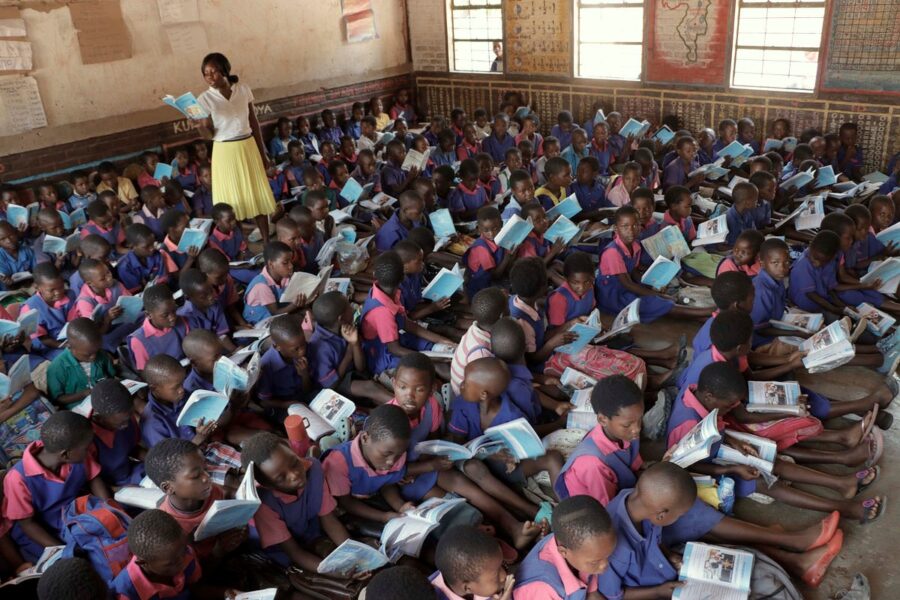
The report finds that an average of about 60 learners share a classroom, while roughly 66 learners share one toilet.
Related Posts:
- FULL TEXT: Dapo Olorunyomi’s lecture at Ajayi Crowther University on Nigerian journalism
- From Borno to Oriire: 2,573 abducted in 31 violent Nigerian school attacks over 12 years
- Unsafe, Unprotected: Oyo schoolgirls suffer in silence over lack of menstrual facilities
- Between School and Survival: Why many girls in Oyo State are still missing class
It says the figures point to severe overcrowding and significant sanitation gaps in public schools.
The authors say Nigeria has expanded access to education at an unprecedented scale, but investment in classrooms, teachers, infrastructure, school leadership and governance systems has not matched demand.
“The result is a system that is increasingly overcrowded, under-resourced, and unable to consistently deliver quality learning outcomes,” the report says.
Low education spending
According to the report, Nigeria allocated 0.3 per cent of its Gross Domestic Product (GDP) to public education in 2025, describing the level as significantly lower than spending in many comparable African countries.
However, the report says the problem goes beyond funding. It identifies fragmented planning, weak implementation, limited use of education data and poor coordination among institutions as major constraints on the sector.
“Nigeria’s education challenge is no longer defined solely by access; it is increasingly one of system capacity,” the authors say.
Data-driven reforms proposed
The report recommends strengthening the Digital Nigeria Education Management Information System (DNEMIS) through integrated state-level education management systems.
It also calls for multi-year investments in classrooms, teachers and digital infrastructure, as well as evidence-based teacher deployment, improved instructional quality and stronger school leadership.
Other recommendations include annual infrastructure and learning-performance scorecards, targeted support for vulnerable learners and clearer coordination among the Federal Ministry of Education, state governments, State Universal Basic Education Boards (SUBEBs), Teaching Service Commissions (TESCOM) and Local Government Education Authorities.
Drawing lessons from Botswana, South Africa and Namibia, the report says improved education outcomes require institutions that can plan continuously, manage performance and ensure accountability.
It adds that progress should be measured not only by the number of children enrolled or classrooms built, but by whether governments can use evidence to improve teaching, strengthen school leadership and ensure learning outcomes.
Source: Development Reporting