



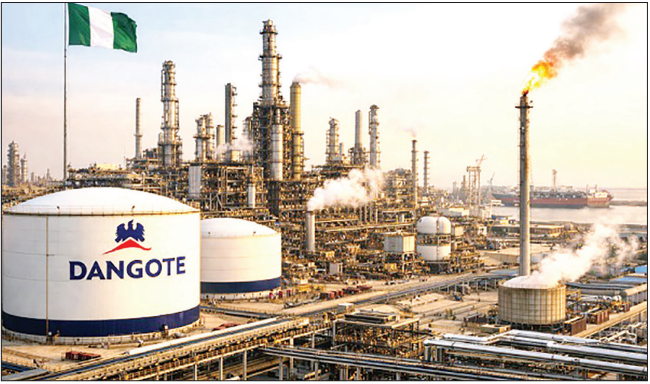
…IPO: Targets 10m shareholding, assures of good dividends
The Group Vice President, Oil & Gas, Dangote Industries Limited, Edwin Devakumar, has said the Dangote refinery was working to ensure uniform pricing of petrol across Nigeria.
He stated that the company had activated a mechanism of free delivery of petroleum products across the state to actualise the vision.
He said the company was desirous of ensuring reasonable pricing across Nigeria even with rising crude oil prices in the international market.
He spoke on Friday during a media tour of the refinery at Lekki Free Zone in Lagos in furtherance of the sensitisation efforts for the Dangote Refinery Initial Public Offering (IPO).
He said: “In the coastal countries, if you check, then you will see the impact of the fuel prices of the Dangote refinery in Nigeria. So, our fuel prices are lower compared to all our neighbours, including those in Niger, Chad, and those who are just by the coast.
“And now, actually, we are even trying to equalise the price, whether you want to buy in Sokoto, whether you want to buy in Maiduguri, whether you are going to buy in Calabar, the price should be the same. So, that is why we brought all these trucks.
“So, we can even subsidise the transport and ensure that there is a uniform price and distribution throughout the country. So, the impact is already there. The only thing is we are even making a further impact while taking the products all over the country and absorbing the transportation costs.”
Devakumar also assured prospective subscribers to its IPO of the commitment of the management of the refinery, including its President, Aliko Dangote, to ensure that they got their dividends, even mouth-watering amounts. He added that the company targets ten million shareholding of the IPO.
He stated that there is no risk in subscribing to the share; however, he asked intending subscribers to do their individual valuations of the share.
He explained that the President of the company has a vision of distributing the wealth of his group to the people through shareholding. He also said Dangote has a vision of job creation and wealth distribution.
Devakumar said: “When you start subscribing for a share, you as an individual will be doing your evaluation. As a company, we believe that there is going to be a very good value appreciation. There will be very good returns in terms of dividends.
“And my president has even declared that the dividends will be in dollars. So, these are the assurances by the president, as the majority shareholder of the company.
“And we have also declared the first six months’ operational results, which will also give you an idea whether the company is profitable or you are going to burn your business.
“So, let everybody become wealthy. Whatever dividend I’m getting, others too can get the same dividend. So, the wealth also should be distributed. So, that is why we went a little bit faster. And our focus was to bring in at least 10 million shareholders, which has never been done in history, in the share market, in the world. So, that’s why we kept a small threshold.
“Anybody can afford it, so anybody at any level can become a shareholder. That is how we became a bit faster after six months of operation. But as an individual, before putting your money, you can always do your own evaluation. But at least, before we went there, when we went on the private placements, we allowed our staff to become shareholders, another private placement.
“Almost all the people in the refinery who know what it is, they all become shareholders, including me. So, we know that it’s not a risk, but you, as an individual, before you put your money, you can make your own evaluation.”
He said that almost all over the world, when they are putting up a major project like this, the projects are funded in two ways.
He explained that one method is a loan, by borrowing from the banks, and that another is equity.
He stated that most of the project, at the project stage, is funded by loans. He, however, said that Dangote had taken a very conscious decision right from day one.
Devakumar said: “If you see any of our projects, whether it is salt or sugar or cement, everywhere we are publicly listed. Our philosophy is to go and invest, complete the project, bring it to operations, start declaring your profit, and then go public. So, what we are achieving is that none of the shareholders is taking any risk, because we are selling a company which is already running profitably. So, yes, we too get a benefit, because when I am selling a profitable company, I am going to get a higher price for my share, but we take all the risk.
“The only difference is, in the case of the sugar refinery, we did not wait for a very long time before selling their shares. But the reason why we went in rather quickly, but still, after completion, after commissioning, and after operating for quite some time, with at least six months’ results, we have gone into the market. The reason being that we are also in a hurry to ensure that a lot of people become the co-owners of this company.
“My President had been driving his investments with the second philosophy. The first one was, ‘let’s go for backward integration of every item I was trading.
“So, we went into backward integration. The idea is to create employment. This talk was, ‘What is the legacy I’m going to leave behind? I have already had enough fun, but I need to leave a legacy. People, what will they remember what we need for? So, if I create a lot of employment, people will say, ‘ Oh, this man was there, created opportunities for employment for so many people.’ So, that was the first philosophy.
“The second was, now we are creating employment. And also, let us create wealth in the countries by adding value to the locally available crop material. So, that is how we went into the second phase in various countries. You have limestone; I will add value. You have, at least, you don’t have limestone like in Cameroon or in Ghana, but you have other additives. I’ll put in a grinding plant and add value. So, this was the second phase, creating wealth in the country.
“First was to create employment. Number two was to create wealth in the country. Then, the third step we have been thinking about is passing on part of my wealth to the people. So, let everybody become whatever dividend I’m getting; others too can get the same dividend.”