








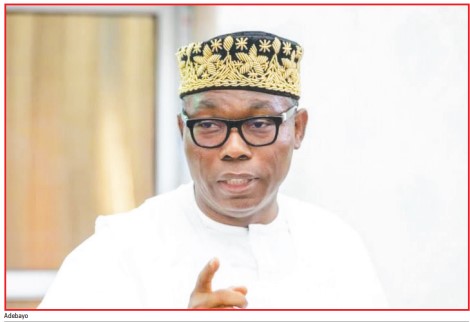
Presidential candidate of the Social Democratic Party (SDP), Prince Adewole Adebayo, has proposed a new model of federalism that would transform Nigeria’s states and local governments from dependants of Abuja into active engines of economic development.
Adebayo’s proposal is contained in his 2027–2031 policy blueprint, “Farewell to Poverty and Insecurity,” which identifies Cooperative Federalism and Subsidiarity as central principles of his governance agenda.
Under the proposed framework, the Federal, State and Local Governments would operate as development partners while retaining their constitutionally assigned responsibilities.
The model envisages greater collaboration among the three tiers through joint planning, counterpart funding, shared standards, interoperable systems and performance-based partnerships in areas where their responsibilities overlap.
Adebayo, however, said his vision would not create a system in which the Federal Government dictates development from Abuja.
Instead, the blueprint embraces the principle of subsidiarity, which holds that public responsibilities should be handled by the lowest level of government capable of delivering them effectively.
Under the arrangement, the Federal Government would focus primarily on national standards, strategic coordination and functions requiring national scale, while states and local governments would assume greater responsibility for areas they can manage more effectively.
The former presidential candidate also proposed that states and regions should develop economic sectors where they possess comparative advantages.
According to the blueprint, these strengths would then be connected through value chains, inter-state commerce and shared infrastructure to create an integrated national economy.
The objective, Adebayo said, would not be to create isolated regional economies but to build **“one productive Nigerian economy.”**
The proposal forms part of his broader economic programme aimed at moving Nigeria away from dependency and towards self-reliant prosperity by 2031.
Rather than imposing uniform development programmes across the country, the blueprint envisages allowing individual states to build around their economic strengths while benefiting from national infrastructure, access to wider markets and coordinated investment.
Adebayo’s proposal could significantly alter the traditional relationship between the Federal Government and the federating units by shifting the focus from administrative control and allocation to economic cooperation and development partnership.
Under his model, federalism would not simply determine which tier of government controls particular functions but would establish how each level can contribute most effectively to national development.
The SDP candidate argues that Nigeria’s federal structure, properly harnessed, could become an economic advantage by bringing together the different comparative strengths of its regions into a coordinated national production system.
The proposed approach is expected to give states greater incentive to develop their productive capacities, attract investment and create jobs, while ensuring that national coordination and infrastructure support economic activities across regional boundaries.
Ultimately, Adebayo’s vision places economic productivity at the centre of federalism, with Abuja serving less as a central controller and more as a strategic coordinator of a network of productive federating units.