










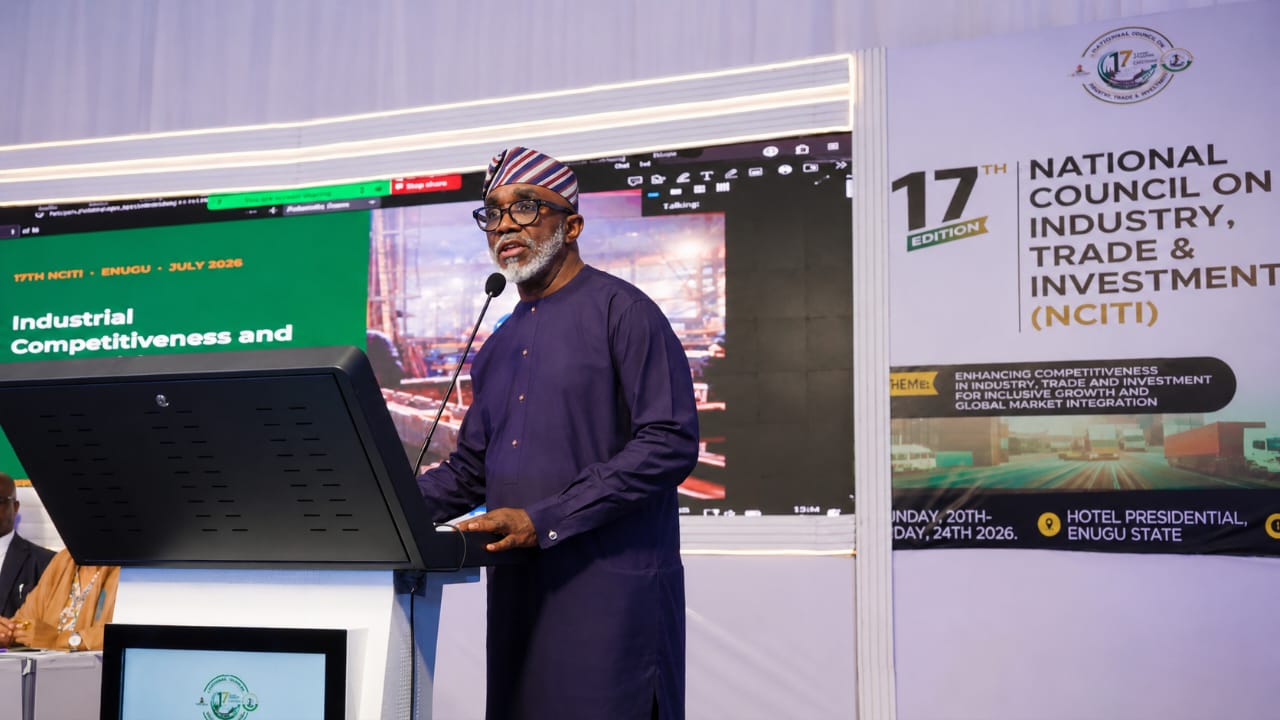
Nigeria must decide whether to become a leading manufacturing hub for Africa or surrender its market to more competitive economies, Executive Secretary of the National Sugar Development Council (NSDC), Mr. Kamar Bakrin, declared at the technical session of the 17th National Council on Industry, Trade and Investment (NCITI) in Enugu.
Presenting what he described as the “arithmetic of a factory floor priced out of contention,” Bakrin outlined four key resolutions aimed at reducing Nigeria’s high cost of production and strengthening the country’s industrial competitiveness, a statement issued over the weekend by NSDC said.
He painted a stark comparison between two manufacturers—one in Aba, Nigeria, and another in Ho Chi Minh City, Vietnam—operating similar factories with equally skilled workers and targeting the same markets.
According to him, by the time products leave the factory gate, the Nigerian manufacturer has already paid between two and ten times more for the three critical inputs every factory depends on: electricity, finance, and logistics.
Bakrin noted that industrial electricity costs manufacturers about 8 cents per kilowatt-hour in Vietnam and 10 cents in China, while Nigerian factories pay approximately 15 cents on the national grid, with costs rising to nearly 30 cents when diesel generators become necessary.
He added that Nigerian manufacturers spent an estimated ₦1.34 trillion generating their own electricity last year.
“Every factory in Nigeria is effectively running a second, unwanted business as a private power station,” he said.
Access to finance presents another major challenge. While manufacturers in Vietnam borrow at around 9 percent and those in China at approximately 3 percent, Nigerian businesses face interest rates ranging between 27 and 35 percent. On logistics, Nigeria ranks 88th out of 139 countries on the World Bank’s Logistics Performance Index, compared to Vietnam’s 43rd and China’s 19th.
These structural disadvantages, he argued, have limited manufacturing to just 8 percent of Nigeria’s GDP, while factory capacity utilization has fallen to 57.7 percent, despite the country’s domestic market of over 230 million people and duty-free access to 1.4 billion consumers under the African Continental Free Trade Area (AfCFTA).
“This is not a demand problem,” Bakrin emphasized. “Africans are ready to buy Nigerian products. It is a cost-of-production problem—and unlike demand, production costs are within our control.”
He argued that recent macroeconomic reforms have created a more stable environment for industrial investment, citing declining inflation and foreign reserves reaching $51 billion, their highest level since 2009. At the same time, he said, global supply chains are shifting, creating a narrow window of opportunity for countries prepared to attract manufacturing investment.
“A factory established elsewhere today is unlikely to relocate tomorrow,” he warned. “Under AfCFTA, either Nigerian goods will cross African borders, or products from other countries will dominate our own market. We must choose whether to compete or concede.”
To demonstrate that industrial transformation is achievable, Bakrin highlighted Nigeria’s urea fertilizer industry, which expanded production capacity from 500,000 tonnes in 2005 to 6.5 million tonnes today, making Nigeria one of the world’s top ten exporters of nitrogen fertilizer. He attributed the success largely to the government’s decision to price natural gas as an industrial input rather than purely as a revenue source.
“The lesson is simple,” he said. “When a country prices critical inputs to help industry thrive, industry thrives.”
Drawing parallels with Vietnam’s electronics sector and Bangladesh’s garment industry, Bakrin stressed that sustained policy discipline—not natural resource wealth—has driven their manufacturing success.
He proposed measurable national targets to improve competitiveness, including reducing industrial electricity costs to 8–10 cents per kilowatt-hour, providing single-digit interest loans to manufacturers, cutting port clearance times from the current 18–21 days to fewer than seven days, and doubling worker productivity by 2030.
Bakrin also presented four resolutions for adoption by the Council:
Every state should establish at least one industrial cluster with dedicated and reliable power within the next 12 months.
Federal and state governments should harmonize taxes and eliminate multiple levies and illegal checkpoints along industrial corridors.
An annual State Industrial Competitiveness Index should publicly rank states based on power supply, land access, taxation, and logistics performance.
“Nigeria First” procurement policies should be fully enforced across federal and state governments, with quarterly public compliance reports.
He stressed that each resolution must have clear ownership, measurable milestones, and implementation timelines.
“Every resolution needs a named owner, a deadline, and a way to measure success. Otherwise, it becomes another document that gets filed and forgotten,” he said.
Bakrin further argued that government incentives—including tax credits, subsidized electricity, and procurement preferences—should be tied to measurable performance rather than automatic entitlement. He cited the NSDC’s Backward Integration Programme as an example, where government support is linked to independently verified production outcomes.
He also challenged state governments to take greater responsibility for improving industrial competitiveness by implementing electricity market reforms under the Electricity Act 2023, making industrial land more accessible and bankable, simplifying taxation, and aligning technical education with the needs of targeted industries.
“Competitiveness is built locally,” he noted. “No federal directive has ever removed a roadside checkpoint.”
According to Bakrin, reducing production costs would create millions of factory jobs for the approximately four million young Nigerians entering the workforce annually, lower consumer prices, strengthen the naira through increased exports and import substitution, and reduce the growing trend of skilled workers emigrating in search of opportunities.
He concluded by urging the Council to adopt clear annual performance benchmarks, including increasing manufacturing’s contribution to GDP to 15 percent, lowering industrial power costs and lending rates, reducing port clearance time to under seven days, expanding exports across Africa, and creating productive employment for Nigeria’s growing workforce.
“The reform phase of Nigeria’s story has begun,” Bakrin said. “The industrial chapter will be written in kilowatt-hours, lending rates, and port efficiency. The opportunity is here—but it will not remain open forever.”