








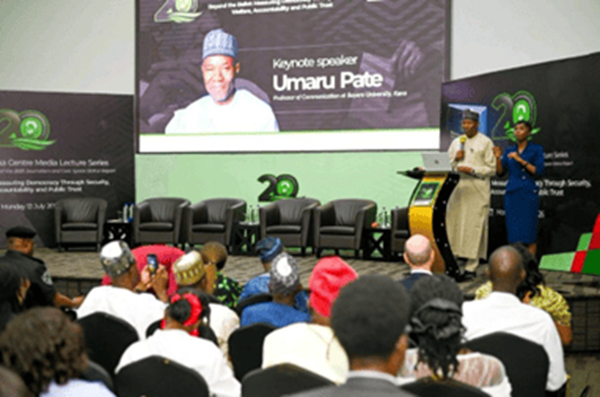
Nigeria’s democracy remains largely procedural, centred on elections and constitutional order, but has failed to deliver the economic welfare, social justice, security and citizens’ rights that define democratic governance, the immediate past Vice Chancellor of the Federal University Kashere, Gombe State, Umaru Pate has said.
Mr Pate, a professor of communication at Bayero University, Kano (BUK), made the submission on Monday while delivering the keynote address at the 18th Wole Soyinka Centre for Investigative Journalism (WSCIJ) Media Lecture in Lagos, themed ‘Beyond the Ballot: Measuring Democracy Through Security, Welfare, Accountability and Public Trust.’
According to him, democracy should not be measured solely by periodic elections but by the extent to which it delivers security, quality education, economic opportunities, citizens’ welfare, accountability and the protection of fundamental rights.
He maintained that while elections remain an essential component of democratic governance, they are not sufficient on their own. According to him, citizens evaluate democracy through their everyday experiences rather than constitutional provisions.
Related Posts:
- FULL TEXT: Dapo Olorunyomi’s lecture at Ajayi Crowther University on Nigerian journalism
- As Nigeria savours WAFCON, AfroBasket wins, data shows many sportspersons died in road crashes in Q2 2025
- From Borno to Oriire: 2,573 abducted in 31 violent Nigerian school attacks over 12 years
- INTERVIEW: Nigerian govt deliberately impoverishing lecturers to kill public education – ASUU President, Piwuna
To support his argument, Mr Pate cited findings from the Afrobarometer survey across 39 African countries, which found that although most Africans prefer democracy to other forms of government, only about 57 per cent are satisfied with how democracy functions in their respective countries, including Nigeria.
He also referenced the 2024 African Youth Survey, which polled about 5,600 young people across Africa. According to the survey, 60 per cent of respondents want to emigrate because of corruption, while about one in three believe democracy offers no future for them.
Weak governance fuels insecurity
Mr Pate said Nigeria’s development indicators equally raise questions about democratic performance.
Citing figures from United Nations Children’s Fund (UNICEF), the United Nations Population Fund (UNFPA) and the National Bureau of Statistics (NBS), he said Nigeria’s population has reached about 230 million, with approximately 18.7 million children out of school and an average life expectancy of just 55 years.
He argued that insecurity across many parts of the country is closely linked to the gradual collapse of local government administration.
According to him, local governments once played vital roles in resolving community disputes, supporting agriculture, providing primary healthcare and maintaining grassroots security before losing financial resources and administrative autonomy.
Drawing from research he conducted around the Lake Chad region years before the Boko Haram insurgency emerged, he recalled visiting communities with thriving economic activities but virtually no government presence.
“There were no schools, no security institutions and no effective governance structures,” he said, adding that such conditions created fertile ground for insurgency.
He warned that misinformation has become one of democracy’s biggest threats. “Today, the problem is not the absence of information in our democracy, but the abundance of information, much of it inaccurate, and the scarcity of attention,” he said.
According to him, Nigeria’s political elite must build consensus around national priorities if the country is to achieve meaningful democratic progress.
Earlier, the immediate past Board Chair of WSCIJ, Repo Sekoni, a professor, declared the lecture open, saying there could hardly be a more fitting time to reflect on what happens before and beyond the ballot. He noted that the conversation was both timely and necessary as Nigeria continues its democratic journey.
Panel calls for accountability beyond elections
The keynote address was followed by a Democracy Delivery Conversation moderated by TV360 Nigeria Founder and Editor-in-Chief, Deji Badmus.
Panellists examined the responsibilities of government institutions, election management bodies, security agencies, the media and citizens in strengthening democratic governance beyond election cycles.
Mr Pate reiterated that democracy can only be strengthened when communities become more actively involved in governance.
According to him, rebuilding community spirit provides the foundation for stronger engagement at state and national levels.
Speaking on voter turnout, the Deputy Director and Head of Voter Education, Publicity, Gender and Civil Society at the Independent National Electoral Commission (INEC), Taiwo Gbadegesin said turnout in the last presidential election stood at about 27 per cent, while recent governorship elections recorded between 34 and 38 per cent.
He attributed the declining voter turnout partly to the political class, arguing that elected officials must fulfil campaign promises if they expect citizens to remain engaged in the democratic process.
“INEC and the media have continued to educate voters, but politicians also have a responsibility to earn the people’s trust,” he said.
The Deputy Commissioner of Police, Department of Finance and Administration, Anthony Placid acknowledged public distrust of security agencies during elections but noted that law enforcement agencies were largely exonerated after the last general election.
He said the police had introduced community partnership initiatives, including the deployment of body-worn cameras, to improve transparency and accountability, adding that rebuilding public trust requires closer collaboration between citizens and security agencies.
Also speaking, the General Manager of Radio Now 95.3FM, Nabilah Usman described radio as Nigeria’s most accessible medium for millions of people living in poverty.
She cited the country’s latest multidimensional poverty report, which estimates that about 133 million Nigerians, more than 60 per cent of the population, live in poverty and often lack access to newspapers or reliable internet services.
According to her, radio therefore remains one of the most effective tools for civic education, pointing to her station’s Radio Now Explains programme, which simplifies public institutions and government policies for listeners.
Netherlands reaffirms support
In his welcome remarks, the Consul General of the Kingdom of the Netherlands in Lagos, Michel Deelen, reaffirmed his country’s support for the Wole Soyinka Centre for Investigative Journalism, disclosing that the Netherlands has supported the organisation since 2007 and funded its last two Journalism and Civic Space Status Reports.
Reflecting on Nigeria’s democratic journey since 1999, Mr Deelen said the country has sustained democratic rule for 27 years despite inflation, currency depreciation and insecurity.
He identified poverty and weak educational outcomes as Nigeria’s greatest development challenges but expressed optimism about the country’s future, citing its vibrant entrepreneurial ecosystem and the growing adoption of digital publishing platforms by journalists.
The event also featured a special farewell side chat between the Executive Director/CEO of WSCIJ, Motunrayo Alaka and Mr Deelen, as he concludes his diplomatic assignment in Nigeria.
The event concluded with the cutting of a birthday cake in honour of the 92nd birthday of the grand patron of WSCIJ, Wole Soyinka, a professor and Nobel Laureate.
Source: Development Reporting