




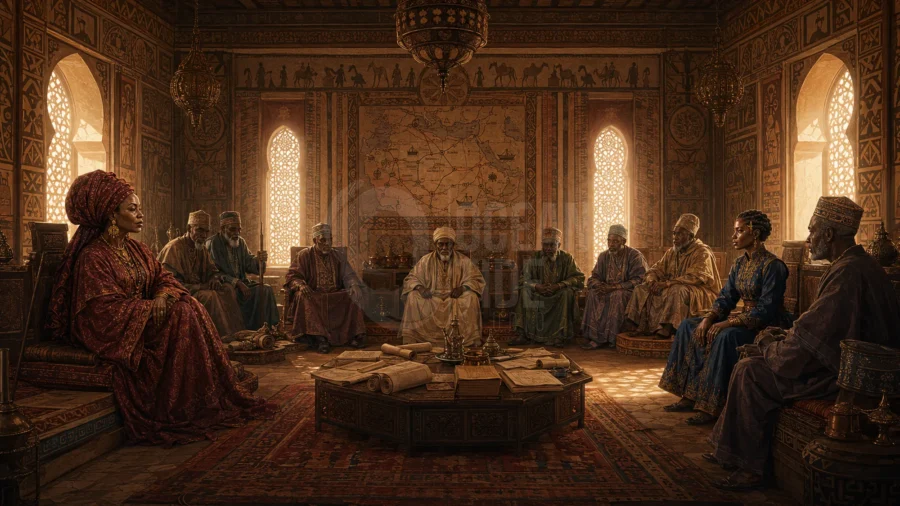
A two-person studio in Abuja can now produce a cinematic animated sequence depicting the court of a 16th-century African emperor, and have it look like it cost $10 million. I know, because I have done it. Here is the methodology, the breakthrough technique, and what it means for the future of African storytelling.
The Problem We Were Trying to Solve
In 2024, I made a decision that felt audacious at the time: I would produce an animated epic series about the pre-colonial civilisations of Northern Nigeria, the Kanem-Bornu Empire, the Hausa Kingdoms, the Sokoto Caliphate, using nothing but AI tools and a small team. We called it AREWA: Kingdom of Fire & Iron.
The ambition was cultural as much as technical. These are civilisations that rivaled anything in medieval Europe or Asia in sophistication, scholarship, and scale. The Kanem-Bornu Empire lasted over a thousand years. The ancient city of Kano had universities, trade networks, and architectural wonders while London was still a market town. None of that history exists in mainstream global animation. There is no African equivalent of the animation treatment given to Greek myths, Norse sagas, or Japanese samurai epics, not at the quality level that reaches global audiences.
I wanted to change that. But changing it the traditional way, building a full animation studio, hiring 50 artists, raising $5 million in production budget, was simply not realistic for an independent studio operating in Nigeria. The economics do not work that way for African creators.
What AI gave us was a different set of economics. And when you change the economics, you change who gets to tell stories.
Related Posts:
- FULL TEXT: Dapo Olorunyomi’s lecture at Ajayi Crowther University on Nigerian journalism
- From Shame to Fame: Story of Fabilola, brain behind ‘Masoyinbo’
- From Borno to Oriire: 2,573 abducted in 31 violent Nigerian school attacks over 12 years
- Unsafe, Unprotected: Oyo schoolgirls suffer in silence over lack of menstrual facilities
When you change the production economics, you change who gets to tell stories.
The Stack: What we actually built with
Let me be specific, because vague references to ‘AI tools’ are not useful. Here is the exact pipeline we developed at Ocean Tides Studios for AREWA: Kingdom of Fire & Iron.
The Ocean Tides AI Production Stack
ChatGPT Dall-E & Midjourney v6, Visual bible, character concept art, environment design. Google Flow & Runway Gen-4 + Act-Two, Scene animation, motion generation, actor-driven performance. Claude, Script development, scene planning, storyboard logic, prompt engineering. ElevenLabs, Voice synthesis, multilingual performance (Hausa, English). Kling, Lip-sync, supplementary motion. Runway Aleph + Workflows, Post-production (Davinci Resolve), colour grading, broadcast output.
The critical insight is that no single tool does everything. What we built is a workflow, a structured sequence of human creative decisions and AI-assisted execution. The director’s vision moves through the stack in stages, with each tool amplifying a specific dimension of the production.
The most common mistake I see from people experimenting with AI animation is trying to find one tool that does it all. That tool does not exist. What exists is architecture. And building the right architecture is a creative act.
The Breakthrough: The Reference-Lock Method
If there is a single technical contribution I am most proud of from this work, it is what we developed to solve the hardest problem in AI animation: character consistency.
Here is the problem in plain terms. When you generate video using AI, the model does not ‘remember’ your character the way a human animator does. Each generation is probabilistic. The result is that your lead character’s face might shift slightly between shots. Their costume details drift. Their skin tone subtly changes between lighting conditions. For a short video, this is manageable. For a narrative series with the same characters appearing across dozens of scenes? It breaks storytelling entirely.
We tried the conventional approach, using the same prompt, hoping the model would stay consistent. It does not. The variance is inherent to how these models work.
So we developed what I now call the Reference-Lock Method.
How the Reference-Lock Method works
For each principal character in AREWA, we constructed a locked visual reference set, a library of 8 to 12 canonical images showing that character from multiple angles, in multiple lighting conditions, in multiple emotional states. These were produced in ChatGPT Dall-E& Midjourney using a tightly controlled prompt architecture, then curated down to a set with zero unintended variance.
We then used these images in two ways. In Runway, the anchor image, one locked, canonical front-facing reference, is used as the mandatory input for every scene generation involving that character. In our prompts, we prepend a character-specific descriptor block to every generation: a structured description of the character’s core visual properties that never changes, regardless of scene context.
Finally, we applied a cross-scene quality gate: every generated scene featuring a principal character is checked against the canonical reference set before it enters the production cut. Specific attributes are checked, facial geometry, costume fidelity, skin tone under the specific scene lighting, proportional consistency. Anything that fails is regenerated.
The result: we went from approximately 60% character recognition consistency in early tests to over 90% in the final pipeline. For a production at the scale of AREWA: Kingdom of Fire & Iron, that difference is the difference between a series that works narratively and one that does not.
The Four Steps of the Reference-Lock Method
1. Reference Set Construction: Build 8–12 canonical images per character across angles, lighting, and emotional states using controlled prompt variation.
2. Anchor Image Locking: Assign a single locked front-facing reference as mandatory input for all scene generation. Store in a version-controlled asset library.
3. Prompt Consistency Architecture: Write a character-specific visual descriptor block. Prepend it to every generation prompt involving that character, no exceptions.
4. Cross-Scene Quality Gate: Evaluate every generated scene against the reference set. Use a structured checklist. Regenerate anything that fails before it enters the cut.
The Cultural Dimension: Why This Matters Beyond Technique
I want to step back from the methodology for a moment and say something about what this work is actually for.
There is a phrase I keep returning to: narrative sovereignty. The right and capacity of communities to tell their own stories, in their own voice, at their own quality standard. African literary scholars have argued for this principle for decades, Ngugi wa Thiong’o, Chinua Achebe, Chimamanda Ngozi Adichie have all articulated, in different registers, the problem of whose stories get told, by whom, and to whose benefit.
Animation adds a specific dimension to this problem. High-quality animation has historically required industrial infrastructure, large studios, expensive software, hundreds of skilled artists. The entry cost has been so high that African historical narratives, which require research-intensive visual world-building, not just generic character animation, have simply not been economically viable for the studios that could produce them, and not technically accessible to the studios that wanted to.
AI changes that calculus. When Ocean Tides Studios can produce a scene depicting the architectural grandeur of the Bornu Court, the layered Islamic architecture, the court regalia, the military formation of the Kanem warriors, at near-broadcast quality, something structural shifts. The barrier was never the story. African history is extraordinary. The barrier was always the production infrastructure.
We now have production infrastructure.
The barrier to African epic animation was never the story. African history is extraordinary. The barrier was always production infrastructure. We now have that.
What African Studios Need to Do Right Now
I am going to be direct here, because I think the African creative technology community sometimes moves too slowly when the moment calls for urgency.
The window for early advantage in AI creative production is open right now. The tools are accessible. The cost is manageable for a small studio with serious intent. The global market for AI-produced content is growing. And the demand for African stories, authentic, high-quality, culturally grounded African stories, is demonstrably real, as Wakanda Forever, The Woman King, and the consistent global performance of Afrobeats-adjacent content have all shown.
Here is what I would tell any African animation studio or independent filmmaker who wants to move:
- Start with your story, not your tools. The technology serves the narrative, not the other way around. If you do not have a story worth telling, no AI pipeline will save you.
- Invest in your visual bible before you invest in generation. The quality of your pre-production reference work determines the ceiling of everything downstream. Spend time here.
- Learn the Reference-Lock Method or develop your own equivalent. Consistency is the problem. Solve it structurally, not on a shot-by-shot basis.
- Document your creative process rigorously. Not just for AI purposes, for IP protection, for investor decks, for co-production partnerships, and for the increasingly important question of creative attribution in AI-assisted work.
- Think about multilingual delivery from day one. ElevenLabs and equivalent tools make it possible to produce in Yoruba, Hausa, Swahili, Amharic, and English simultaneously. The African market is multilingual. Your production pipeline should be too.
The Honest Limitations
I would be doing you a disservice if I presented this as a story with no friction. There are real limitations.
Temporal consistency in action sequences remains the hardest unsolved problem. When characters are in motion, combat, running, crowd scenes, the Reference-Lock Method reduces variance but does not eliminate it. Fast action sequences currently require more regeneration passes than dialogue scenes.
AI tools trained predominantly on Western visual datasets carry aesthetic biases that require active counteraction. Producing accurate visual representations of Hausa court architecture, Kanuri military regalia, or Fulani pastoralist clothing requires deep historical research and iterative prompt refinement. The tool does not know this history by default. You have to bring it.
The IP and legal landscape for AI-generated content is genuinely unsettled. Consult a lawyer before you sign distribution deals. Understand what you own and what you can assert. This is not scaremongering, it is basic due diligence.
And AI is not a substitute for creative vision. Every producer I know who has tried to use AI tools to compensate for a weak creative idea has produced weak AI content. The tools amplify what you bring to them.
Where We Go From Here
AREWA: Kingdom of Fire & Iron is in active production. We are in parallel developing the AI production pipeline as a transferable methodology, the kind of structured, documented framework that other African studios can adopt and adapt.
The vision is not one studio producing one series. The vision is an African AI animation ecosystem, a generation of culturally committed creative technologists who combine deep knowledge of African history and storytelling with command of the AI production stack.
The Kanem-Bornu Empire at its height was one of the largest polities in the world. The ancient Hausa city-states were centres of trans-Saharan commerce and Islamic scholarship. The Sokoto Caliphate was the largest state in Africa at the time of its founding. These are not minor footnotes in world history. They are epics waiting to be made.
We are making them. And we are building the infrastructure so that others can too.
Source: Development Reporting