






President Bola Tinubu has tasked the leadership of the African Export-Import Bank (Afreximbank) to intensify efforts to mobilise and deploy the continent’s vast human, financial and natural resources for the collective economic advancement of Africans, stressing that Africa’s drive towards industrialisation must move beyond theory to practical action.
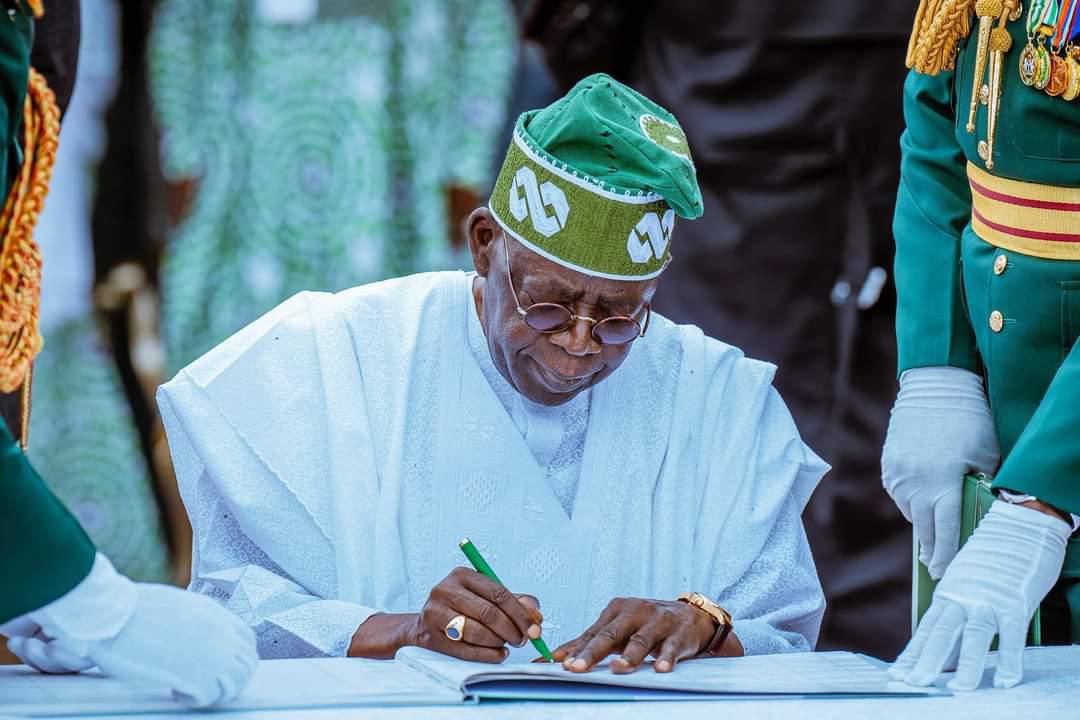
The President stated this on Tuesday while receiving a delegation from Afreximbank, led by its President and Chairman of the Board of Directors, Dr. George Elombi, at the State House, Abuja.
In a statement issued by his Special Adviser on Information and Strategy, Bayo Onanuga, Tinubu said his administration’s recent economic reforms, including the removal of fuel subsidy and the unification of the foreign exchange market, were necessary steps to combat corruption and ensure economic stability.
He emphasised that Africa possesses enormous potential and must move beyond endless conversations about development to practical actions that drive industrial growth, expand trade, create jobs, add value to raw materials and improve the living standards of its people.
According to him, structured financial support and reliable infrastructure are essential for building the continent’s economy.
“The conscience and the future of Africa depend on what you and your team can do and will do for Africa as a whole, and the time has come for us to start doing things together as Africans.
“We have what it takes to build this continent. Do we continue to exploit and export raw materials without value addition? The answer is no.
“We have solid mineral deposits such as lithium and others that can be utilised, and you, as the financial partner, should be able to provide investment guarantees for production and value addition in batteries and other manufacturing ecosystems,” the President said.
Speaking on the farmer-herder conflict, Tinubu told the delegation that his administration has transformed the longstanding challenge into an economic opportunity through the establishment of the Federal Ministry of Livestock Development.
“I created the Ministry of Livestock Development to create economic opportunities for Nigerians. The cotton, ginning and garment industries are major job creators. If we partner effectively, incorporate these ideas and focus less on talking and more on implementing development programmes, we can transform the economy,” the President said.
Tinubu also called on Afreximbank to collaborate with the Bank of Agriculture, invest more in the production and value addition of crops such as cocoa, palm kernel and palm oil, and ensure that agricultural value chains deliver tangible benefits to Nigerians.
In his remarks, the Minister of State for Industry, Senator John Owan Enoh, highlighted the President’s economic diversification agenda, describing the Eight-Point Renewed Hope Agenda as a transformative blueprint repositioning Nigeria for sustainable economic growth, industrial expansion and shared prosperity.
Enoh said Tinubu’s commitment to industrialisation, particularly through the development of the solid minerals sector, oil and gas, manufacturing, agriculture, the digital economy and value-added exports, is laying the foundation for a resilient economy that is less dependent on crude oil revenues.
Earlier, Elombi said he and his team visited the State House to thank President Tinubu for his support, which contributed to his emergence as President of Afreximbank, and to brief him on the bank’s operations and investments in Nigeria.
According to him, the bank has significant investments across trade, agricultural processing, value chains and healthcare.
He also highlighted the bank’s efforts to reduce medical tourism in Africa, disclosing that Afreximbank has invested between $15 billion and $20 billion in the Nigerian economy over the past five years.
Elombi invited President Tinubu to visit the African Medical Centre of Excellence (AMCE) in Abuja, describing it as one of the bank’s flagship healthcare investments on the continent.