





The Federal Ministry of Marine and Blue Economy (FMMBE) has called for stronger collaboration among the Federal Government agencies, state governments, private sector and development partners to accelerate the implementation of Nigeria’s National Policy on Marine and Blue Economy (NPMBE) for economy growth.
Its Minister, Dr Adegboyega Oyetola on Thursday urged coastal states to align their development plans with the national policy while encouraging greater private investment in fisheries, aquaculture, maritime transport, tourism, shipbuilding, renewable energy and marine biotechnology.
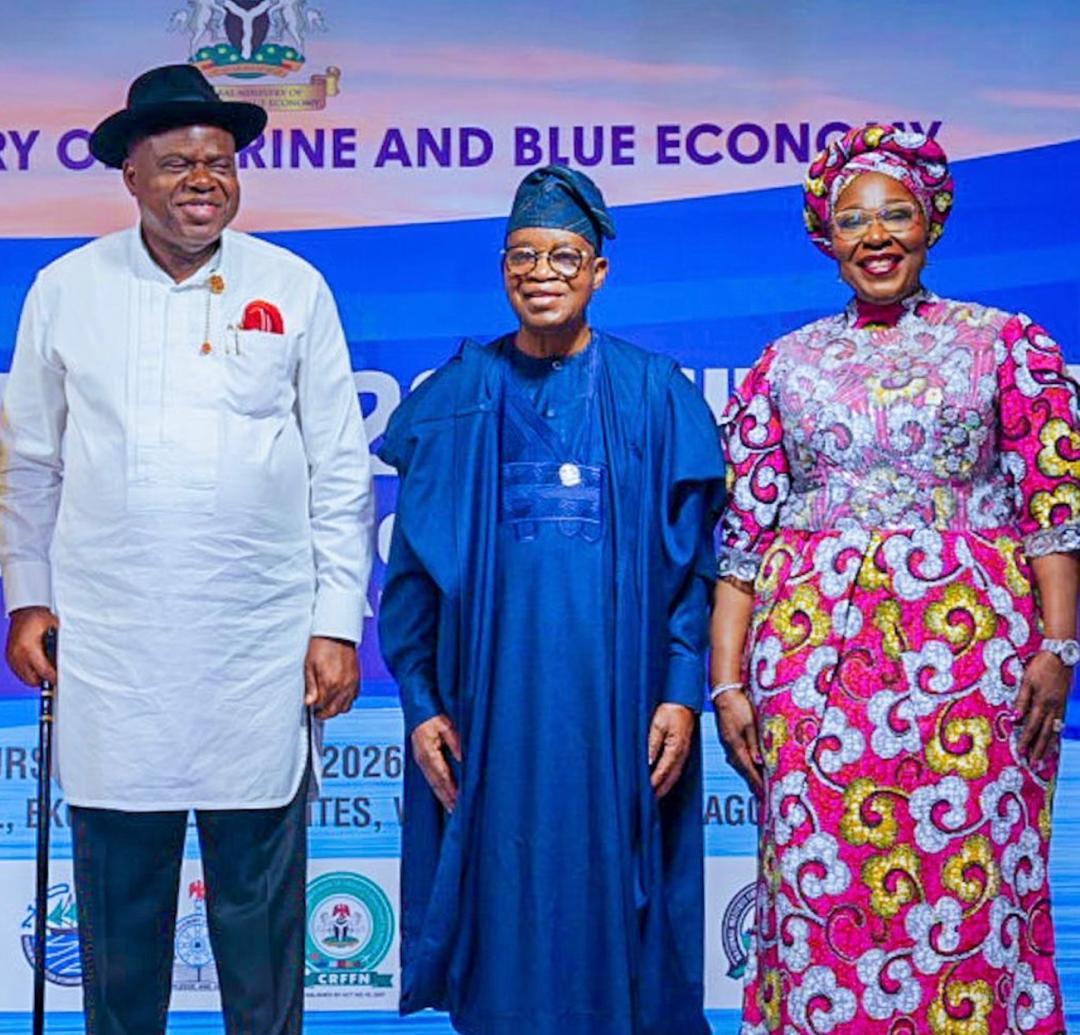
At the Second Quarter 2026 Citizens’ and Stakeholders’ Engagement held at Eko Hotel and Suites, Victoria Island, Lagos, the minister noted that Nigeria had moved beyond policy formulation and must focus on implementation that delivers tangible economic benefits.
The forum themed: “From Policy to Action: Mobilising Sub-National Governments for Effective Implementation of Nigeria’s National Policy on Marine and Blue Economy,” brought together government officials, diplomats, development partners, industry leaders, academics and state government representatives.
Oyetola explained the policy provides a roadmap for unlocking the economic value of Nigeria’s oceans, inland waterways, fisheries and coastal resources, stressing that state governments are central to its success because many of these assets lie within their jurisdictions.
Also, the minister added reforms under President Bola Ahmed Tinubu’s Renewed Hope Agenda had improved stakeholder engagement, strengthened maritime safety, attracted investment and enhanced port competitiveness, citing the 2025 Container Port Performance Index (CPPI) by the World Bank and S&P Global Market Intelligence, which ranked Tin Can Island Port as the world’s 10th most improved port and Lagos Port Complex, Apapa, as the 12th most improved between 2020 and 2025.
Oyetola stressed that the ongoing port modernisation and proposed deep seaports in Akwa Ibom, Bayelsa, Cross River, Lagos and Ondo states would reinforce Nigeria’s ambition of becoming West Africa’s leading maritime hub.
He said that the improved port efficiency had contributed to Nigeria recording a sustained trade surplus since 2024.
He highlighted the nationwide distribution of life jackets and renewed collaboration with relevant agencies and state governments, while urging operators to replace unsafe wooden passenger boats with modern fibre vessels.
Delivering the keynote address, Bayelsa State Governor, Duoye Diri, commended the establishment of the Federal Ministry of Marine and Blue Economy, describing it as a strategic step towards economic diversification.
The governor added that Bayelsa established its own Ministry of Marine and Blue Economy in June 2024 and has since expanded fish production at the Bayelsa Aquaculture Village in Yenegwe, upgraded marine transport services and intensified efforts to develop the proposed Agge Deep Seaport.
Diri outlined five priorities for coastal states: establishing dedicated blue economy ministries, enacting enabling legislation, securing maritime domains, investing in reliable data and developing skills, logistics infrastructure and innovation hubs.
Also, the President of Dangote Industries Limited, Aliko Dangote, represented by Managing Director of Dangote Port Operations, Mr. Akin Omole, posited sustained private sector participation would determine the success of the national policy.
He stressed that the policy aims to create three million jobs within four years, achieve annual sectoral growth of seven per cent and reserve at least 50 per cent of new jobs for Nigerians aged 18 to 35.
Dangote identified policy consistency, quality infrastructure, access to finance and investor confidence as critical drivers of industrial transformation, adding that infrastructure development, value-chain expansion and stronger public-private partnerships remain essential for unlocking the sector’s potential.
He said that the new deep seaport projects approved across the country would stimulate industrial clusters covering agro-processing, petrochemicals, shipbuilding, cold-chain logistics and maritime technology.
Dangote described fisheries as one of Nigeria’s biggest investment opportunities, noting that the country still imports nearly $1 billion worth of fish annually despite growing domestic production. Increased investment in aquaculture, hatcheries, feed production, processing, cold-chain logistics and export infrastructure.
He noted that the country hcould cut imports, save foreign exchange, create more than 500,000 jobs and position Nigeria as a major fisheries exporter, stressing that effective public-private partnerships should extend beyond financing to include collaboration among government, investors, research institutions and coastal communities.
Goodwill messages were delivered by the Deputy Governor of Akwa Ibom State, Senator (Dr) Akon Eyakenyi; Chairman of the Senate Committee on Marine Transport, Senator Wasiu Sanni Eshinlokun; representatives of the governors of Ondo and Borno states, and private sector stakeholders, who reaffirmed their commitment to advancing Nigeria’s marine and blue economy agenda.