









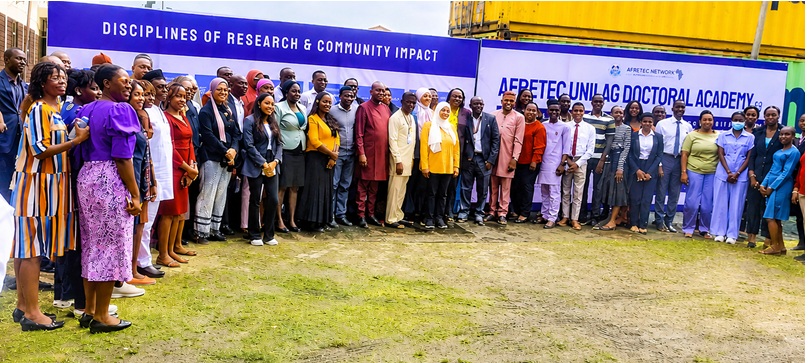
The Vice Chancellor of the University of Lagos (UNILAG), Folasade Ogunsola, a professor of Medical Microbiology, has called on doctoral researchers to find innovative solutions to the challenges facing Nigeria and the African continent.
She spoke at the opening of the second edition of the African Engineering and Technology Network (AFRETEC) UNILAG Doctoral Academy, themed “Doctoral Research as a Catalyst for Community Impact.”
Mrs Ogunsola told participants that the continent is confronted with many problems that are yet to be solved and urged researchers to be the ones to provide solutions.
She said a professor told her 20 years ago that “the straws are in the wind but soon they will fall,” while she urged participants to keep contributing their own straws until lasting change comes. “So keep throwing up the straws and one day everything will fall,” she said.
Related Posts:
- FULL TEXT: Dapo Olorunyomi’s lecture at Ajayi Crowther University on Nigerian journalism
- Experts push sustainability-driven computing at UNILAG software engineering summer school
- Unsafe, Unprotected: Oyo schoolgirls suffer in silence over lack of menstrual facilities
- From Borno to Oriire: 2,573 abducted in 31 violent Nigerian school attacks over 12 years
AFRETEC broadens support for doctoral researchers
A Professor of Welding Process Analysis and Fusion-based Surface Modification, Abdulhakeem Amuda, who represented the AFRETEC Network Coordinator at UNILAG, Ismail Ibrahim, a professor of Communication and Media Studies, explained that (AFRETEC) is a consortium of engineering-focused universities across Africa.
The network, piloted by Carnegie Mellon University Africa and funded by the Mastercard Foundation, according to him is dedicated to strengthening research capacity on the continent.
Mr Amuda said AFRETEC operates around four pillars: teaching and learning, knowledge creation, pathways to opportunities, and inclusion and diversity. He noted that the Doctoral Academy is one of the network’s flagship initiatives under the knowledge creation pillar, alongside its Early Career Mentorship Programme, adding that this year’s event is the second edition.
He further disclosed that the academy has expanded beyond UNILAG and universities in South-West Nigeria, where it debuted last year, to include participants from Nigeria’s six geopolitical zones and universities across Africa. According to him, the expansion reflects AFRETEC’s growing commitment to fostering collaboration and building a stronger community of doctoral researchers across the continent
Why researchers must engage communities
Delivering a keynote address on “Research as a Catalyst for Community Impact,” Morenikeji Ukpong, a professor of Child Dental Health at Obafemi Awolowo University (OAU), asked doctoral researchers to see themselves as change agents rather than people merely pursuing degrees.
She told participants that an early career researcher is anyone working within a university, whether at undergraduate, postgraduate or staff level, since all are still building their research careers.
Mrs Ukpong noted that African researchers often collaborate along old colonial lines, with French-speaking African countries linking up with France and Nigeria linking up with the United Kingdom, instead of partnering more with one another.
She added that data from research on diseases that affect Africa, such as HIV, malaria and tuberculosis, mostly comes from researchers based outside the continent.
“For every one research from the global South, Africa, you’re having 50 others from the global North,” she said.
This, according to Mrs Ukpong, happens partly because African researchers collect data and samples for foreign institutions without signing memoranda of understanding (MoU), and partly because some researchers adopt foreign institutional addresses once they secure fellowships abroad, leaving their work credited to other countries.
She referenced a study which found that 73 per cent of researchers who carry out community-focused research do not receive high citation rates for it, and that 61 per cent of African researchers surveyed in another study said the pressure to publish leaves them little time for community engagement.
Mrs Ukpong gave an example of research she has conducted in Yoruba communities on the use of dental and other health services, explaining that she designed the studies with community members from the outset instead of treating them merely as research subjects.
She urged researchers to ensure that data collected from communities is not taken out of the country without consent or acknowledgement, describing this as an issue of data sovereignty.
This practice, she said, has caused some communities in South Africa and Canada to stop allowing researchers into their communities unless invited.
Research commercialisation
A Professor and Director of the Nanoelectronics and Devices Centre at Zewail City of Science and Technology and the American University in Cairo, Ismail Yehea, presented a session titled “Doctoral Research and the Entrepreneurial Bridge,” which focused on commercialising research.
He told participants that anyone who wants to commercialise their research must first decide whether to publish it, patent it or keep it as a trade secret, noting that publishing research removes the right to patent it later.
Mr Yehea explained that not every patent is commercially valuable, since a patent must be both discoverable and enforceable to protect against copying. He advised universities to focus on commercialising mid-level technology rather than simple consumer software, which young developers can easily build, or extremely advanced technologies such as quantum computing, which he said require investments.
He said there are two common paths to commercialising research: licensing a patent through the university, where revenue is typically shared among the university, the department and the inventor, or establishing a spin-off company to develop the product.
Mr Yehea said anyone going into research commercialisation must understand that the work is mostly development rather than research, since most of the time is spent fixing problems and adapting products for different applications rather than generating the initial idea.
He identified government agencies, private investors and non-profit organisations as the three main sources of funding for research commercialisation, adding that each requires a different approach when seeking support.
Alumni share stories of growth and success
Several participants from the first edition of the Doctoral Academy shared how the programme has influenced their academic and professional journeys.
Okunowo Oluwafemi, who studies the use of virtual technology to teach Biology, said the academy gave him greater confidence to apply ethical research methods. He said he has since co-authored a book on artificial intelligence tools for African educators with a fellow participant, Iman Tamisola-Badugu, which is scheduled to be published on Amazon by the end of the month.
Noimot Balogun, who said she once believed only doctoral graduates trained abroad could publish in high-impact journals, said seeing a fellow UNILAG scholar do so during the first academy changed her perspective. She has since had three manuscripts accepted in high-impact journals across two institutions while her research on digital surveillance for cholera was recently used by the Lagos State Ministry of Health and the Nigeria Centre for Disease Control and Prevention (NCDC) to update public health communication materials.
A PhD student in the Department of Geosciences at UNILAG, Sobowale Soremi said the academy taught him how to make his research more impactful, adding that, this helped him secure a place among 1,000 applicants selected for the American Geophysical Union’s Voices for Science programme, through which he now organises science outreach activities for communities.
Sakina Zurakat-Aderibigbe, a radiography lecturer at UNILAG pursuing her PhD at Bayero University, Kano, said the academy motivated her to take charge of her research timeline instead of waiting for her supervisor. She said she completed her research proposal within six months of attending the academy and has since had an abstract accepted for presentation at a conference of the International Society for Magnetic Resonance in Medicine in Cape Town, South Africa.
Idris Adesina, a PhD candidate in Organisational Psychology at Babcock University, said the academy taught him to move from descriptive to analytical research. He said he has since published in three Category A journals, including PMC Psychology.
Source: Development Reporting