









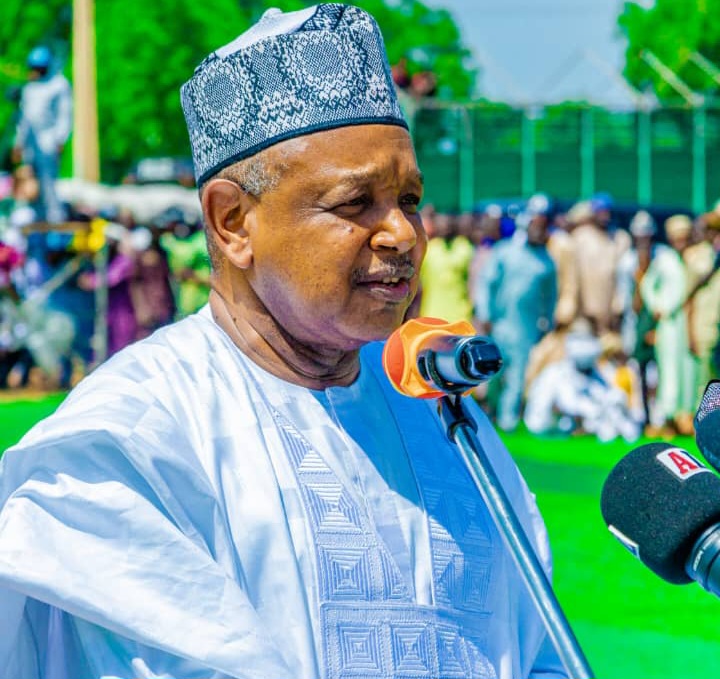
The Minister of Budget and Economic Planning, Senator Abubakar Bagudu, has urged Austrian investors to look to Nigeria for investment opportunities, saying the economic reforms of President Bola Tinubu have repositioned the country as an attractive destination for foreign capital.
Bagudu made the call on Tuesday while addressing the GPF Global Vienna Meeting in Vienna, Austria, via a video message on the theme, “Financing Africa’s Future: The Vienna Stock Exchange as a Gateway to European Capital Markets for African Government Projects.”
The Minister said Nigeria’s large market, with a population of more than 200 million people, offered Austrian businesses, particularly technology-driven companies, significant opportunities for profitable investments.
“We are confident that Nigeria is a proven market of choice with strong absorptive capacity, with over 200 million people. So, Austrian companies and businesses well-rooted in technology can operate profitably in Nigeria,” he said.
Bagudu said the Tinubu administration’s economic reforms, aimed at restoring macroeconomic stability and investor confidence, had produced significant gains within three years.
According to him, the reforms eliminated distortions in the economy, including in the foreign exchange market, while creating a more transparent and rule-based environment for investors.
He said the measures had helped stabilise the macroeconomy and improve the predictability of the foreign exchange market.
“The forex market has stabilised, with free entry and exit. Foreign reserves have risen significantly to over $50 billion, providing over 11 months of import cover,” Bagudu said.
The minister also linked the reforms to increased government revenues across the three tiers of government, saying the development had strengthened their capacity to provide essential services to citizens.
Making a case for stronger Austrian investment in Nigeria, Bagudu said improved bond spreads reflected growing confidence in the Nigerian economy, while the two countries shared demographic and economic characteristics that could support deeper investment ties.
He said Nigeria’s ambition to grow into a $1 trillion economy by 2030 had made the mobilisation of foreign capital a key priority, with the Austrian capital market offering an important avenue for achieving that objective.
To deepen investment cooperation between both countries, Bagudu disclosed that the Ministry of Budget and Economic Planning, the Ministry of Finance and Austrian officials, working with the Austrian Stock Exchange, had established ESME Limited as a special purpose vehicle to facilitate investment financing in Nigeria.
He said the company, which has representatives of the Ministry of Finance Incorporated and prominent Austrian businessmen on its board, would issue bonds on the Vienna Stock Exchange to finance investments in Nigeria.
The funds, he added, would support projects in green technology, waste-to-energy, textiles, pharmaceuticals, agriculture and water, as well as help existing businesses scale up their operations.
Bagudu expressed optimism that the forthcoming bond issuance would strengthen economic and business relations between Nigeria and Austria.
He assured prospective investors that they would find Nigeria a rewarding investment destination, noting that some existing investors in the country were earning returns of more than 20 per cent in US dollar terms.
“Prospective investors would not regret doing business in Nigeria,” he said.